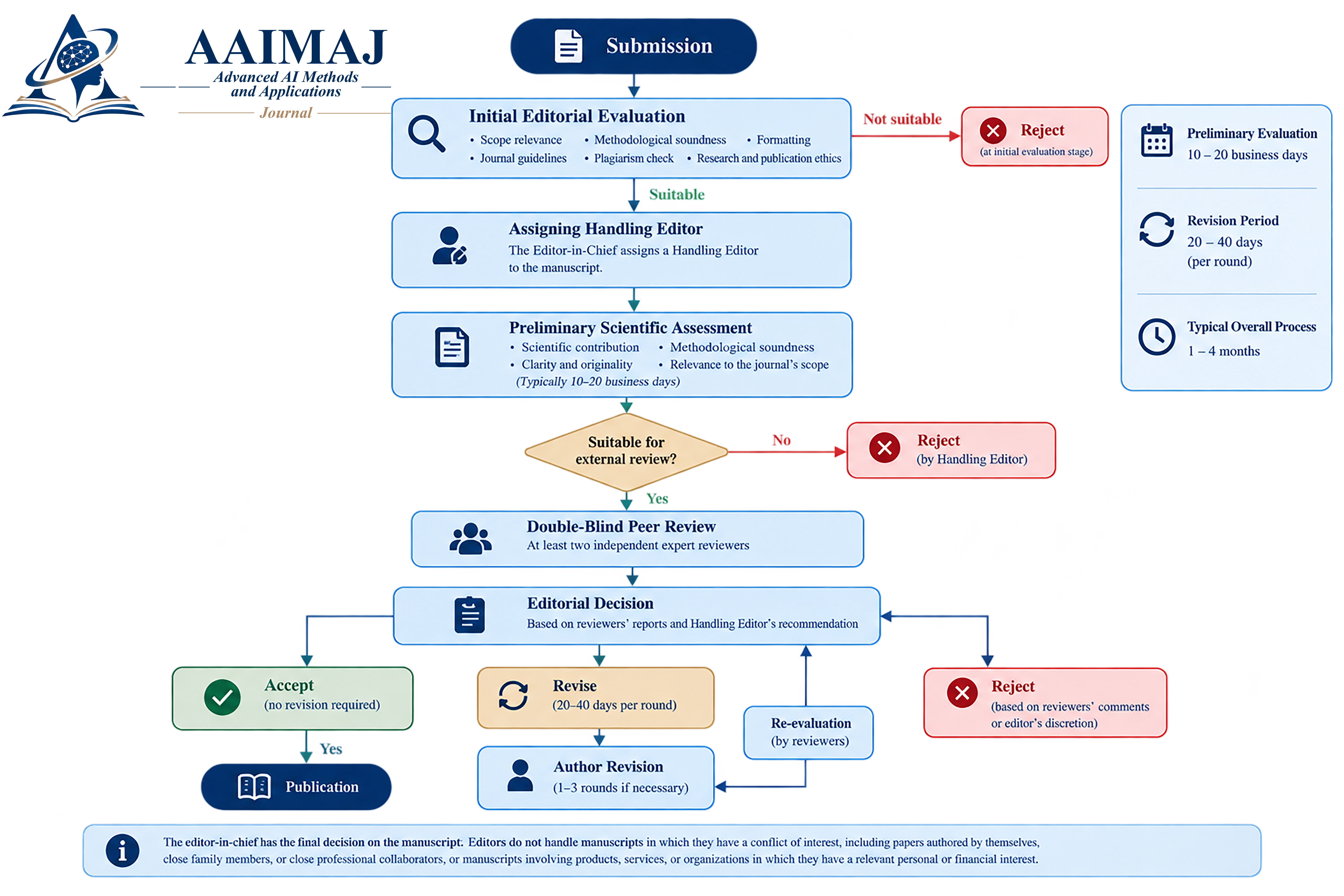
The peer review process at Advanced AI Methods and Applications (AAIMA) follows a rigorous double-blind peer-review procedure designed to ensure fairness, confidentiality, and objective evaluation of submitted manuscripts. All manuscripts are assessed according to the journal’s editorial and scientific standards before being considered for external peer review.
In the first stage, submitted manuscripts undergo an initial editorial evaluation to determine their relevance to the journal’s aims and scope, compliance with the journal’s submission requirements, overall scientific suitability, methodological quality, originality, and adherence to research and publication ethics. Manuscripts that are clearly outside the journal’s scope, fail to meet essential submission requirements, or do not satisfy the journal’s basic scientific and ethical standards may be rejected or returned to the authors at this stage.
Manuscripts that successfully pass the initial evaluation are assigned by the Editor-in-Chief to a Handling Editor, who conducts a preliminary scientific assessment of the manuscript. This assessment considers the scientific contribution, methodological soundness, clarity, originality, and relevance of the research to the scope of AAIMA. This preliminary evaluation typically takes 10 to 20 business days. Manuscripts considered suitable for external evaluation are subsequently sent to at least two independent expert reviewers with appropriate subject-matter expertise.
Reviewers independently evaluate the manuscript and provide their comments and recommendations to the Handling Editor. The identities of both authors and reviewers are kept confidential throughout the double-blind review process. Reviewers are expected to assess manuscripts objectively, maintain confidentiality, disclose any potential conflicts of interest, and provide constructive comments that support the editorial decision.
Based on the reviewers’ reports and the Handling Editor’s assessment, the manuscript may receive one of the following decisions:
Accept: The manuscript is considered suitable for publication without further substantive revision. Following completion of the necessary editorial and production procedures, the article proceeds to publication.
Revise: The manuscript requires revision in response to the reviewers’ and/or editor’s comments. The corresponding author is normally expected to submit a revised manuscript within 20 to 40 days. Authors are encouraged to address all comments comprehensively and provide a clear response to each point raised. Depending on the extent of the revisions, a manuscript may undergo two or more rounds of review before a final decision is reached.
Reject: A manuscript may be rejected when the reviewers identify substantial scientific, methodological, ethical, or conceptual deficiencies, when the manuscript does not meet the journal’s publication standards, or when the Handling Editor or Editor-in-Chief determines that the manuscript is not suitable for publication.
The Editor-in-Chief has overall responsibility for the final editorial decision, taking into consideration the reviewers’ evaluations and the recommendations of the Handling Editor. Editorial decisions are made independently and are not influenced by commercial, financial, personal, or other competing interests. Where applicable, authors may submit an appeal in accordance with the journal’s Complaint and Appeal Policy.
The complete review process, including peer review and revision stages, typically takes approximately 1 to 4 months, although the actual duration may vary depending on the complexity of the manuscript, reviewer availability, the number of review rounds required, and the time taken by authors to prepare revisions.
To protect editorial independence, editors do not handle manuscripts in which they have a conflict of interest, including manuscripts authored by themselves, close family members, or close professional collaborators, or manuscripts involving products, services, or organizations in which they have a relevant personal or financial interest. Such manuscripts are handled independently by an appropriate alternative editor.
A schematic overview of the peer-review process is provided in the figure below.